
Why Does My Child Forget What They Learned? A Parent’s Guide
Wednesday night your child sat at the kitchen table and reviewed their spelling words for twenty minutes. They knew every
Proudly serving North American families since 1989
Proudly serving North American families since 1989
Proudly serving North American families since 1989
Proudly serving North American families since 1989

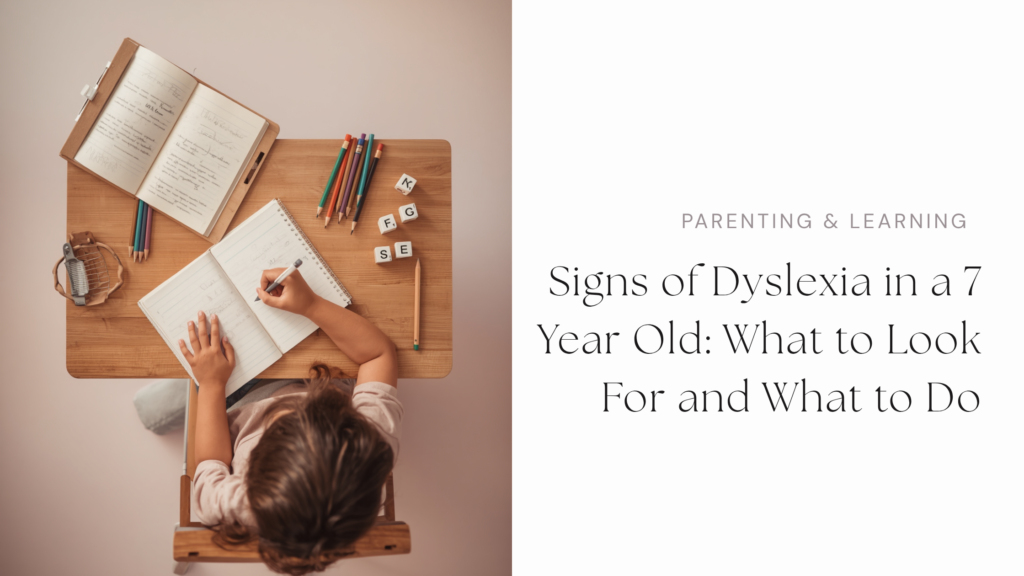
It is reading night in your house. Your seven-year-old is sitting at the kitchen table, and every word on the page is a battle. They squint, they guess, they sound out letters that do not seem to connect into anything meaningful. They are not unhappy or difficult- they are trying. You can see that clearly. And yet somehow, the words just will not come.
You might be wondering whether this is normal, whether you should wait a little longer, or whether something specific is going on that no one has put a name to yet. The word that may have crossed your mind- or perhaps someone at school mentioned- is dyslexia.
Here is what every parent should know: dyslexia is not about intelligence. In fact, many children with dyslexia are exceptionally bright, creative, and curious. What dyslexia affects is the brain’s ability to connect sounds to letters- a process called phonological processing. And the earlier it is identified, the better the outcomes.
The signs of dyslexia in a 7-year-old often include difficulty reading age-appropriate words, inconsistent spelling, guessing words instead of decoding them, letter reversals, reading avoidance, and slower progress compared to peers. Dyslexia is a language-based learning difference that affects how the brain processes sounds and written language. Early identification and evidence-based dyslexia programs can help children build stronger reading skills, confidence, and academic success.
Dyslexia is a language-based learning difference that affects reading, spelling, and sometimes writing. It has nothing to do with vision problems (the letters are not actually moving or flipping, despite what many people believe). It is a difference in how the brain processes the sounds within words.
In Canada, dyslexia affects approximately one in five children. At age seven, children are typically expected to be reading simple sentences independently and decoding new words using phonics. When this is not happening, it is worth paying attention- not to panic, but to investigate.
If you recognize four or more of these in your child, it is a strong signal that a proper assessment would be beneficial.
Dyslexia does not mean your child is lazy. It does not mean they are not trying hard enough. It does not mean they cannot learn to read fluently. And it absolutely does not limit what they can achieve in life. Many successful lawyers, doctors, engineers, entrepreneurs, and artists have dyslexia. What they all needed- and what your child needs- is the right kind of teaching.
Many parents wonder whether their child simply needs more practice or whether specialized support is necessary. For children with dyslexia, targeted intervention is often the key to success. Research-based dyslexia reading programs are designed to strengthen phonological awareness, decoding, spelling, reading fluency, and comprehension skills.
A structured dyslexia learning program provides systematic instruction that helps children understand the relationship between letters and sounds. Working with a trained dyslexia tutor or participating in specialized dyslexia tutoring can help children develop reading skills in a way that matches how they learn best.
The earlier a child begins a dyslexia remediation program, the greater the opportunity to build strong reading foundations and reduce academic frustration.
The brain is most neuroplastic- most open to rewiring and new learning- between the ages of 5 and 10. Structured, evidence-based reading intervention delivered at age 7 produces dramatically better outcomes than the same intervention at age 12. This is not about rushing your child. It is about taking advantage of a natural window in brain development when reading pathways can be built most efficiently.
Waiting to see if your child grows out of it is, unfortunately, one of the most common mistakes parents make. Children with dyslexia do not grow out of it- they adapt around it, and those adaptations often create new problems: avoidance, low self-esteem, and falling further behind in every subject that requires reading.
The first step is not to panic- it is to get information. A proper assessment by a trained specialist will tell you exactly what your child is experiencing and what kind of support will help them.
At Strategic Learning Clinic, we use a four-step assessment process to identify the specific nature of your child’s reading challenges. We then design a completely individualized program- we do not use worksheets or generic tutoring. Our programs, including the Lindamood Phoneme Sequencing program in English and Simultaneous Multisensory Teaching based on the Orton-Gillingham method in French (EMS), are based on the strongest current research in reading science and have helped thousands of children learn to read fluently.
We work with families in Montreal in person, and with families across Canada and the United States virtually.
Yes. Strategic Learning Clinic offers individualized dyslexia support, assessments, and evidence-based reading programs for children in Montreal and through virtual services across Canada and the United States.
The most effective support typically includes structured literacy instruction, individualized intervention, dyslexia tutoring, and evidence-based dyslexia reading programs tailored to the child’s needs.
If your child consistently struggles with reading, spelling, or phonics compared to peers, a professional assessment can help identify underlying challenges and guide appropriate support.
Yes. With the right dyslexia support, structured instruction, and evidence-based reading intervention, children with dyslexia can become confident and capable readers.
Common signs include difficulty sounding out words, inconsistent spelling, slow reading progress, guessing words, letter confusion, and frustration during reading activities.
Wednesday night your child sat at the kitchen table and reviewed their spelling words for twenty minutes. They knew every

When It’s Not Just One Subject Some children struggle with reading. Others struggle with math. But many parents notice something

When Reading Looks Fine but Something Feels Off Many parents come to us with the same concern. Their child